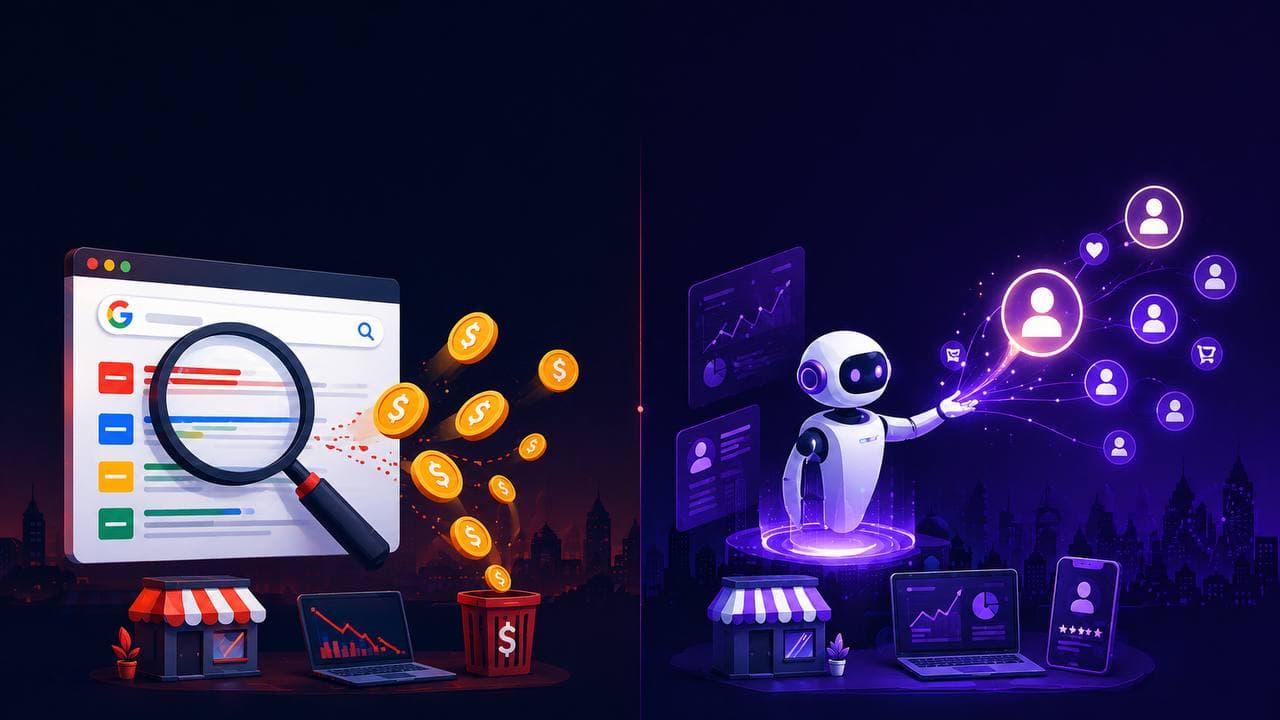

A business owner we know — let's call him Amit — runs a growing electronics store in Nagpur. Last year he signed up for a free CRM. Free email marketing tool. Free invoice app. Free AI chatbot for his website. Total cost: ₹0.
Six months later, three things happened in the same week.
A competitor started running ads targeting exactly his customer list — same pin codes, same product categories, same price brackets. His invoice app started showing him a "premium" paywall on features he was already using. And his chatbot vendor announced a new pricing plan, effective in 30 days, with data export locked behind the highest tier.
Amit never paid a rupee for any of those tools. But he paid. Everyone on a free plan pays. The currency is just never printed on the signup page.
The Real Price Tag of "Free"
There's an old line from the early internet: if you're not paying for the product, you are the product. It used to be a clever observation. In 2026, it's an accurate business model description.
Free services earn money in three main ways:
1. Your data becomes their inventory. Every click, purchase, customer record, and search you feed into a free tool builds a profile. That profile gets packaged and sold — to advertisers, to data brokers, to "analytics partners." Meta put an actual price tag on this in Europe: pay roughly ₹1,200 a month, or consent to tracking. That's what your attention and data are worth to one platform alone.
2. Your attention gets sold back to you. Free tools are engineered for engagement, not efficiency. Infinite feeds, notification loops, upsell nudges. The hours your team spends inside these tools are hours monetised by someone else.
3. You get locked in, then billed. The freemium playbook: hook you at ₹0, migrate your workflows and data in, then flip the paywall once switching costs are high. Amit's invoice app wasn't a gift. It was a lease with the rent hidden.
And here's the 2026 twist that makes the old saying outdated: now you often pay AND you're still the product. Paid streaming tiers sell your viewing habits to advertisers. Connected cars were caught selling driving data to insurers. And your content — emails, documents, customer conversations — increasingly flows into AI systems that get better at serving everyone, including your competitors.
Why This Hits Businesses Harder Than Individuals
For a person, being the product means creepy ads. For a business, it means something worse: your customers become the product too.
Think about what goes into a typical free CRM or email tool:
- Customer names, phone numbers, purchase history
- Payment patterns and price sensitivity
- Enquiry data — who wants what, in which city, at what budget
That's not just your data. Under the DPDP Act, much of it is your customers' personal data — and you're the Data Fiduciary responsible for it. When you upload it to a free tool, you're trusting a vendor whose business model is data, with legal liability that is yours.
Read the privacy policy of a typical free business tool and look for two things: "sharing with trusted partners" and "improving our services." Both usually mean your business data can leave your control — and under DPDP, "the vendor did it" is not a defence you can offer your customers.
We covered the DPDP compliance checklist for SMB websites in a previous guide, and the enforcement deadline — May 2027 — is closer than most SMEs think. Free tools with opaque data flows are one of the most common compliance gaps we find in audits.
How to Audit Your "Free" Stack — 6 Checks
Run this against every free tool your business touches. One hour, no technical skills needed.
1. Ask the money question. How does this vendor make money? If the answer isn't "we charge users," the business model is you. Check their pricing page and their investor page — both usually say it plainly.
2. Find the export button before you need it. Can you get ALL your data out — customers, history, invoices — in a standard format (CSV/API), today, on the free plan? If export is gated, delayed, or "coming soon," your data is hostage collateral. Test it now, while you have leverage.
3. Read the data-sharing clauses. Search their privacy policy for "third parties," "partners," and "improve." Count how many ways your data can leave their servers. If you can't count it, assume the worst.
4. Check where your customers' data sits. Which country hosts it? Who can access it? Under DPDP, if you collect Indian customers' data, you need to know the answer — because regulators will ask you, not the vendor.
5. Map what breaks if they die. Free tools shut down, get acquired, or pivot constantly. What's your plan the morning the service is gone? If the answer is "panic," the tool is a liability, not a bargain.
6. Grade the lock-in. If switching costs (re-training staff, migrating data, rebuilding workflows) are higher than a paid alternative's annual fee, "free" is the most expensive thing you own.
The Ownership Alternative
None of this means every free tool is a trap — Wikipedia and open-source software are genuinely free. The test is the business model: does the vendor profit when you succeed, or when you stay?
For tools that touch your customers, your money, or your compliance obligations, the math changes. A paid tool you control — or a system built for your business, on infrastructure you own — shifts you from "user being monetised" to "owner with leverage."
That's the whole idea behind what we build at Mejona: CRM, HR, automation, and customer-facing systems where your data stays in your infrastructure, exportable on day one, DPDP-aligned by default. Not because free is always bad — but because for the data that runs your business, you should be the customer, never the inventory.
Amit migrated off his free stack in three weeks. His tools now cost him about ₹4,000 a month total. His customer list hasn't leaked since — as far as he can tell, which is exactly the point: now he can tell.
The Bottom Line
Free isn't a price. It's a payment method — and the currency is you.
Audit your stack. Ask the money question. Test the exit door. And for anything touching your customers' personal data, remember: under DPDP, you carry the liability no matter whose server it sits on.
Want a second opinion on your current tools? We do free stack audits for Indian SMEs — reach out and we'll tell you plainly what's safe, what's leaking, and what's worth paying for.
Mejona Technology LLP builds web platforms, custom software, and DPDP-aligned systems for Indian SMEs. Based in Patna and Bangalore. We build tech that Indian businesses actually use.
Read the article.
Now ship it.
30 minutes with our Patna & Bangalore engineering team. We'll audit what you have, scope what you need, and send you a written proposal — even if you don't hire us.